Kidney Transplant · Pakistan
Family Donor Kidney Transplant in Pakistan
A family donor kidney transplant in Pakistan means a close blood relative or spouse donates one kidney to a patient, under Pakistan's transplant law and with committee approval. It is the only legal way to do a living donor transplant there. The donor must volunteer freely, pass full medical screening, and be approved before any surgery takes place.

For a Bangladeshi family facing kidney failure, the questions are practical: who can donate, what will the hospital ask, and how long will the trip take? This guide answers those questions for a family donor kidney transplant in Pakistan, with the legal position first, because the law decides who can donate at all.
Who can donate a kidney in Pakistan?
Only close blood relatives and spouses. Parents, siblings and adult children of the patient can donate, and so can a husband or wife with verified marriage documents. Cousins, friends and in-laws outside that list cannot donate, and no payment for an organ is allowed under any circumstances.
Pakistan's Transplantation of Human Organs and Tissues Act, 2010, sets this limit. Before surgery, a Human Organ Transplantation Authority (HOTA) committee interviews the donor alone, away from the family, to confirm the decision is free and unpaid. Any sign of payment or pressure ends the case, and buying or selling an organ is a criminal offence. The World Health Organization explains why countries regulate living donation this way in its guidance on transplantation. Archon Healthcare works only with genuine family donors. We never arrange or source donors, and we never take a case where the donor's consent is in doubt. The full legal steps are covered in our guide to the kidney transplant legal approval process in Pakistan.
What tests does a kidney donor need in Pakistan?
The donor goes through blood group matching, tissue typing, crossmatching, kidney function tests, a CT angiogram, and a full health screen. The work-up usually takes 1 to 2 weeks and runs at the same time as the patient's own evaluation.
The kidney checks come first. Doctors measure the filtration rate (GFR), collect urine over 24 hours, and map the kidney's blood vessels with a CT angiogram. You need two healthy, well-functioning kidneys; the surgeon removes the one with the more suitable anatomy. Compatibility testing follows: blood group, HLA tissue typing and crossmatch, to confirm the patient's immune system will accept the kidney. A positive crossmatch stops the process.
Then comes general health screening: blood pressure, blood sugar, heart evaluation, cancer screening, and tests for hepatitis B and C and HIV. A counsellor or social worker also speaks with the donor to confirm they understand the surgery and the small long-term risks. Conditions such as uncontrolled hypertension, diabetes or significant kidney disease disqualify a donor, for the donor's own protection. The National Kidney Foundation guide to living donation describes the same work-up from the donor's side. Basic tests done in Bangladesh first can shorten the trip. Our family donor travel guide for Pakistan lists what to bring and how to sequence the tests.
How long does a kidney transplant take in Pakistan?
Most families spend 3 to 5 weeks in Pakistan from first tests to flying home. Evaluation takes 1 to 2 weeks, surgery keeps the donor in hospital for 3 to 5 days, and recovery takes another 2 to 4 weeks.
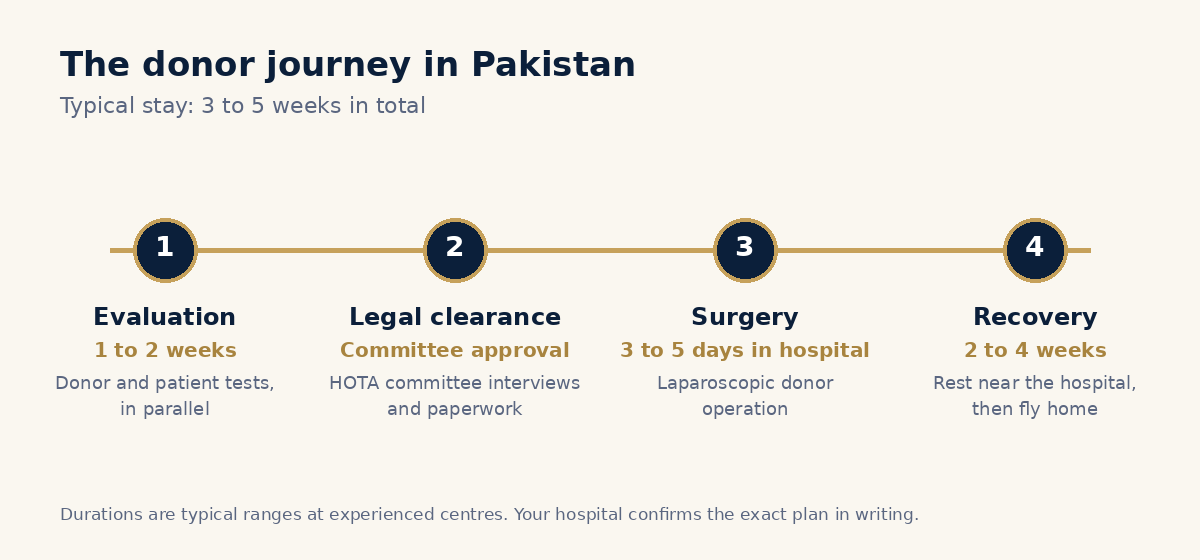
Do not book a tight return ticket. Clearance to fly depends on how the donor is healing, and the recipient usually stays longer than the donor. Families on dialysis while they wait can read our guide to dialysis in Pakistan for Bangladeshi patients.
What does a family donor kidney transplant in Pakistan cost?
The donor's evaluation and surgery are normally bundled into the recipient's transplant package, so the family receives one quotation covering both patient and donor. The surgical package typically ranges from $15,000 to $16,000, with an additional $2,000 to $3,000 for pre-workup, attendant expenses, and initial medicines, per our 2026 cost guide. The full journey can reach $30,000 to $40,000 in complex cases. Always ask for the written, itemised quotation before travelling.
The quotation should spell out what the package covers: donor tests, the donor operation, the hospital stay, and medicines. Travel, accommodation, food and follow-up visits back home are usually separate, so confirm those too. Costs vary by centre and by the patient's condition, so a figure quoted for another family may not match yours. Our kidney transplant cost guide explains how to read a quotation line by line.
Can a kidney donor change their mind in Pakistan?
Yes. A donor can withdraw consent at any point up to the surgery, with no questions asked and no explanation required. The committee protects this right, and it is checked in the private interview.
This matters because donation is a big decision inside a family, and pressure can be quiet. If a donor has doubts, saying so early helps everyone. The hospital will not proceed without a willing donor, and the family is not owed an explanation. If you are the donor and you feel unsure, tell the committee directly during your interview.
What documents do Bangladeshi families need for a kidney transplant in Pakistan?
Passports valid for 6 months or more, NID and proof of the family relationship, the hospital's invitation letter, and the medical records of both patient and donor. The donor and patient travel on medical visas.
Relationship proof means birth certificates for blood relatives and a marriage certificate for a spouse donor. The invitation letter comes from the treating hospital once the case is accepted, and the medical visa application rests on it. Bring your own medical records too: prescriptions, blood pressure logs, and vaccination history. Our medical visa guide for Bangladeshis walks through the document set and the per-country notes, and the legal approval process guide lists the committee paperwork.
How Archon Healthcare coordinates a family donor transplant
We start with the paperwork. Before anyone flies, we check the relationship documents against the legal checklist, so a missing certificate does not surface at the committee interview. Then we coordinate the donor and recipient evaluations in parallel, which saves days, and we sequence the invitation letter, the medical visas and the travel around the hospital's dates.
Through the trip, one team holds the plan: appointments, the hospital stay, and follow-up back in Dhaka. The donor's rights and comfort sit inside that plan from the start. If the medical reports suggest the patient should not travel, we say so. You can read about the coordination on our kidney transplant treatment page and our Pakistan destination page, or contact us with the patient's reports for an honest opinion.
Frequently asked questions
Can a cousin or friend donate a kidney in Pakistan? No. Pakistan's law restricts living donation to close blood relatives (parents, siblings, adult children) and spouses. Unrelated donors are not accepted, and any commercial arrangement is a criminal offence.
Who pays for the donor's tests and surgery? Donor evaluation and the donor operation are normally bundled into the recipient's transplant package at most centres. Always get this confirmed in the written quotation, and clarify whether the donor's travel and accommodation are included or separate.
Is it safe to donate a kidney? For carefully screened donors, the surgery is very safe at experienced centres. Ask the centre for its own audited donor complication figures in writing. Long-term, one healthy kidney compensates fully; donors need annual blood pressure and kidney-function checks but otherwise live normal lives. The NHS Blood and Transplant page on kidney transplantation sets out the same safety picture.
How long does the donor need to stay in Pakistan? Typically 3 to 5 weeks in total: 1 to 2 weeks for evaluation and legal approval, a few days in hospital after surgery, and 2 to 4 weeks of recovery and follow-up before flying home. Do not book a tight return; clearance to fly depends on your healing.
Can the donor change their mind? Yes. A donor may withdraw consent at any point up to the surgery, no questions asked and no explanation required. The transplant committee treats donor autonomy as protected.
This article is general information only. It is not medical advice. Transplant decisions belong to the treating hospital and its doctors, after full evaluation of the patient and the donor.
Discuss your case with us for free
Share your reports and get an honest opinion: the right hospital, the written estimate, and whether you should travel at all.
Chat on WhatsAppEmail Us