Thailand · Visa
Thailand Medical Visa Requirements for Bangladeshi 2026
Bangladeshi patients need a Thai visa before travelling, and the right one depends on how long treatment takes. A tourist visa fits a consultation inside 60 days. The MT medical visa covers treatment of up to 60 days, and the Non-Immigrant O visa covers stays of up to 90 days per entry. Pick the visa that matches your treatment plan.
Can I go to Thailand for treatment on a tourist visa?
Yes, for a short visit. A Thai tourist visa suits a single consultation or a health checkup that fits inside a 60-day stay. It does not suit surgery, a course of chemotherapy, or any treatment that keeps you in Thailand longer than 60 days. For those trips, apply for the medical visa instead, so your stay matches your treatment plan.
What is a Thailand MT visa?
The MT visa is the medical treatment visa for patients travelling for care. Thai consular guidance lists it for treatment of up to 60 days, issued on the strength of a hospital appointment letter. If your treatment runs longer than 60 days, apply for the Non-Immigrant O visa for medical treatment instead, which allows up to 90 days per entry.
How long can I stay in Thailand for treatment?
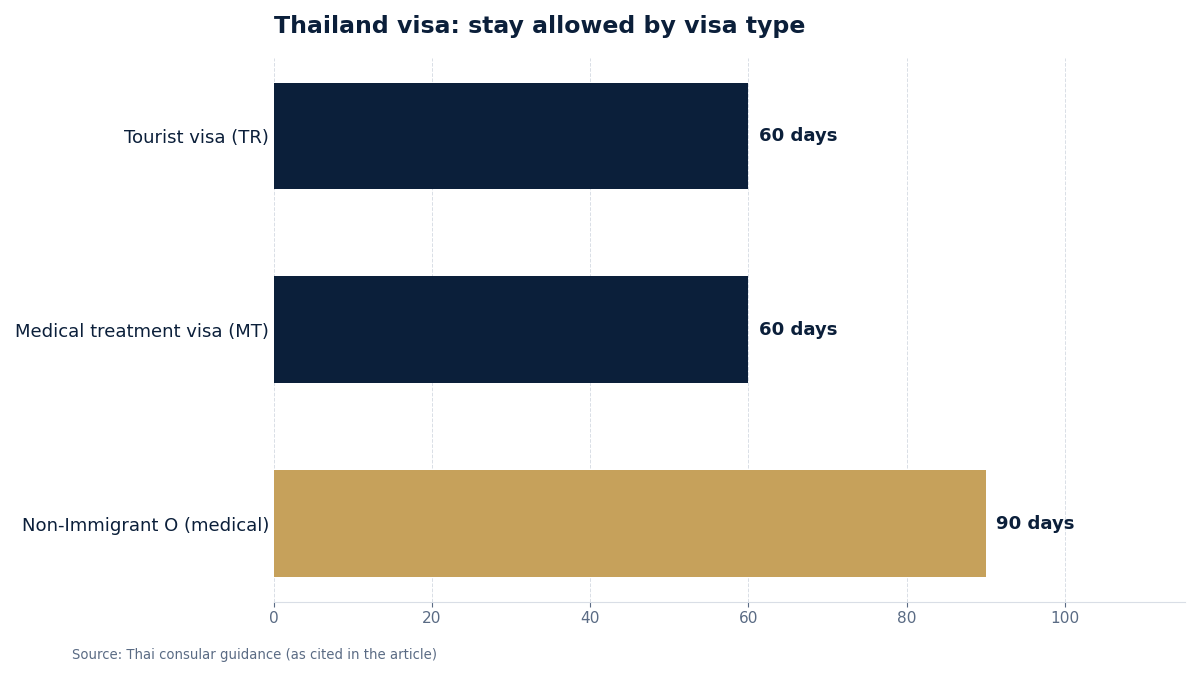
It depends on the visa you hold. A tourist visa allows 60 days, with a 30-day extension at immigration. The MT visa covers treatment of up to 60 days. The Non-Immigrant O visa for medical treatment allows up to 90 days per entry and can be extended inside Thailand with a hospital letter confirming that treatment is under way.
The three visas side by side
The table below compares the three routes a Bangladeshi patient can use. The figures come from Thai consular guidance and the Thai e-Visa portal, checked on 23 November 2026. Fees change, so check the current fee on the e-Visa portal before you apply.
| Visa | Stay allowed | Who it suits |
|---|---|---|
| Tourist visa (TR) | 60 days, extendable by 30 days at immigration | A single consultation or health checkup |
| Medical treatment visa (MT) | Treatment of up to 60 days | Planned treatment with a hospital appointment letter |
| Non-Immigrant O, medical treatment | Up to 90 days per entry, extendable with a hospital letter | Surgery, chemotherapy cycles, or any stay past 60 days |
Bangladeshi passport holders are not eligible for visa on arrival in Thailand. Every patient must hold a visa before boarding the flight from Dhaka. Applications run through the Thai e-Visa portal at thaievisa.go.th, and the Royal Thai Embassy in Dhaka has accepted e-Visa applications from ordinary Bangladeshi passports since 2 January 2025.
What the medical visa application asks for
The hospital appointment letter is the document the application turns on. It must come from the Thai hospital on its own letterhead, and it should state your name, the treatment planned, the appointment dates and the expected length of stay. Without it, the embassy has no medical reason to grant the visa, so get the letter before you start the application.
Alongside the letter, prepare a passport valid for at least 6 months beyond your intended stay, with blank pages for the visa sticker, plus two recent passport-sized photographs taken within the last 6 months against a white background. You will also need the completed visa application form, a medical report from your doctor in Bangladesh recommending treatment in Thailand, and proof of funds such as a bank statement covering the last 3 months.
Other papers the embassy commonly asks for are a confirmed return flight ticket or itinerary, proof of accommodation, and a photocopy of your national ID. Processing from Dhaka typically takes about 10 working days from submission, so apply at least two full weeks before your planned travel date. That gap leaves room for the embassy to ask for an extra document without forcing you to move your hospital appointment.

When the tourist visa is the wrong choice
A tourist visa works when the whole trip fits inside 60 days and the treatment is light. It fails when the treatment itself runs longer than the visa. Surgery with a recovery period, a course of chemotherapy, or an oncology plan spread over several visits will outlast a tourist stay, and the patient then has to extend, change visa type, or leave and return. Each of those fixes costs time, and time is what a patient on treatment has least of.
The extension is available: a tourist visa can be extended by 30 days at a Thai immigration office, for a published fee of 1,900 THB. That covers a short overrun. It does not cover a treatment plan that was always going to take three months. If your hospital letter says the stay will run past 60 days, apply for the Non-Immigrant O medical visa from the start.
One more point on travel during treatment. If you leave Thailand in the middle of a course of treatment, get a re-entry permit from immigration before you go, or the visa is cancelled when you leave. Patients who fly home between chemotherapy cycles have been caught out by this, so build the permit into the plan before the first flight.
Attendants travel on their own visa
The person travelling with you needs a visa of their own. Attendants of medical visa patients normally apply under the tourist (TR) category, with proof of their relationship to the patient. Each attendant applies separately, with their own passport, photographs and bank statement. The hospital appointment letter should name the attendant where the hospital allows it, since the letter supports the whole family application.
Plan the attendant visa at the same time as the patient visa, not after it. A patient who arrives in Bangkok alone because the attendant visa was left to the last week has a harder stay than one who planned both together. If more than one family member is travelling, check with the hospital and the embassy how many attendants the application can carry.
Frequently asked questions
Can I go to Thailand for treatment on a tourist visa? Yes, for a short visit. A Thai tourist visa suits a single consultation or a health checkup that fits inside a 60-day stay. It does not suit surgery, a course of chemotherapy, or any treatment that keeps you in Thailand longer than 60 days. For those trips, apply for the medical visa instead, so your stay matches your treatment plan.
What is a Thailand MT visa? The MT visa is the medical treatment visa for patients travelling for care. Thai consular guidance lists it for treatment of up to 60 days, issued on the strength of a hospital appointment letter. If your treatment runs longer than 60 days, apply for the Non-Immigrant O visa for medical treatment instead, which allows up to 90 days per entry.
How long can I stay in Thailand for treatment? It depends on the visa you hold. A tourist visa allows 60 days, with a 30-day extension at immigration. The MT visa covers treatment of up to 60 days. The Non-Immigrant O visa for medical treatment allows up to 90 days per entry and can be extended inside Thailand with a hospital letter confirming that treatment is under way.
To start a case, share your reports through our patient intake form. We review them with the hospital, arrange the appointment letter, and help with the visa papers.
Last reviewed: 23 November 2026
Discuss your case with us
Share your reports and get an honest opinion: the right hospital, the written estimate, and whether you should travel at all.
Chat on WhatsAppEmail Us