China · Cancer
Targeted Cancer Therapy, Immunotherapy and Proton and Minimally Invasive Options in Guangzhou

Guangzhou offers targeted therapy and immunotherapy for solid tumours through Modern Cancer Hospital Guangzhou, and CAR-T cell therapy for blood cancers through Zhujiang Hospital. Proton therapy is available in the city, at Guangzhou Concord Cancer Center, which is a separate hospital. Which option fits depends on the cancer type, the test results, and the treating team.
Families often arrive in Guangzhou with one drug name in mind, and ask whether a targeted tablet or an immunotherapy infusion can be arranged. The drug is the last part of the decision. The first part is the pathology report, the scans, and what the cancer has already been treated with. This guide sets out what Guangzhou actually offers, hospital by hospital.
What is immunotherapy for cancer?
Immunotherapy is drug treatment that helps the patient's own immune system recognise and attack cancer cells. In Guangzhou it is used mainly as part of a combined plan, for example PD-L1 inhibitors given with seed implantation or interventional therapy. It suits some cancers and some patients only, so the treating team decides from the pathology report.
Some cancers hide from the immune system by switching off the signals that would mark them as a threat. Immunotherapy drugs block that switch, which lets immune cells see the tumour again. The drugs do not work the same way for every cancer, and a tumour with no markers may not respond at all. That is why the hospital asks for the pathology report and the biomarker results before it says yes or no.
At Modern Cancer Hospital Guangzhou, immunotherapy appears in combined plans with other treatments. The hospital's own case reports describe PD-L1 inhibitors used with radioactive seed implantation and interventional chemoembolisation, with the drug timed around the local treatment. Side effects can look different from chemotherapy side effects, so ask which drug they propose, how it pairs with the local treatment, and how reactions are monitored after you return home.
Which targeted therapies are available in Guangzhou?
Modern Cancer Hospital Guangzhou lists targeted therapy among its 18 minimally invasive technologies, together with NanoKnife, cryotherapy, interventional therapy and particle implantation. Zhujiang Hospital runs CAR-T cell therapy for blood cancers through its haematology department. The choice depends on the cancer type and on molecular testing, so no single targeted drug fits every patient.
Targeted therapy is a wide term, so the table below splits it into the forms Guangzhou actually uses, with what the hospital's own pages say about each one. Every entry comes from a hospital published page checked on 23 November 2026.
| Option | Where it is offered in Guangzhou | What the hospital page states |
|---|---|---|
| Targeted drug therapy | Modern Cancer Hospital Guangzhou | Listed among the hospital's 18 minimally invasive technologies, described as treatment that acts on specific cancer cell pathways. |
| NanoKnife (irreversible electroporation) | Modern Cancer Hospital Guangzhou | Listed among the 18 technologies, for soft tissue tumours near vessels and nerves. |
| Cryotherapy | Modern Cancer Hospital Guangzhou | Listed among the 18 technologies, using argon helium freezing to destroy tumour cells. |
| Interventional therapy | Modern Cancer Hospital Guangzhou | Listed among the 18 technologies, delivering drugs directly into the tumour's blood supply. |
| Particle implantation (brachytherapy) | Modern Cancer Hospital Guangzhou | Listed among the 18 technologies, using radioactive seeds placed inside the tumour. |
| CAR-T cell therapy | Zhujiang Hospital, haematology department | The hospital's own news page records more than 400 blood cancer patients treated, with a full process from screening to infusion and follow up. |
| Proton therapy | Guangzhou Concord Cancer Center | First Varian ProBeam proton system in South China, operating since December 2024. Concord is not an Archon partner hospital. |
Two points in that table deserve care. First, CAR-T at Zhujiang is a blood cancer treatment, run by the haematology department, not a general solid tumour option. Second, targeted drug therapy needs molecular testing first. The drug only makes sense when the tumour carries the change the drug acts on, so a written plan should name the test, the result, and the drug together.
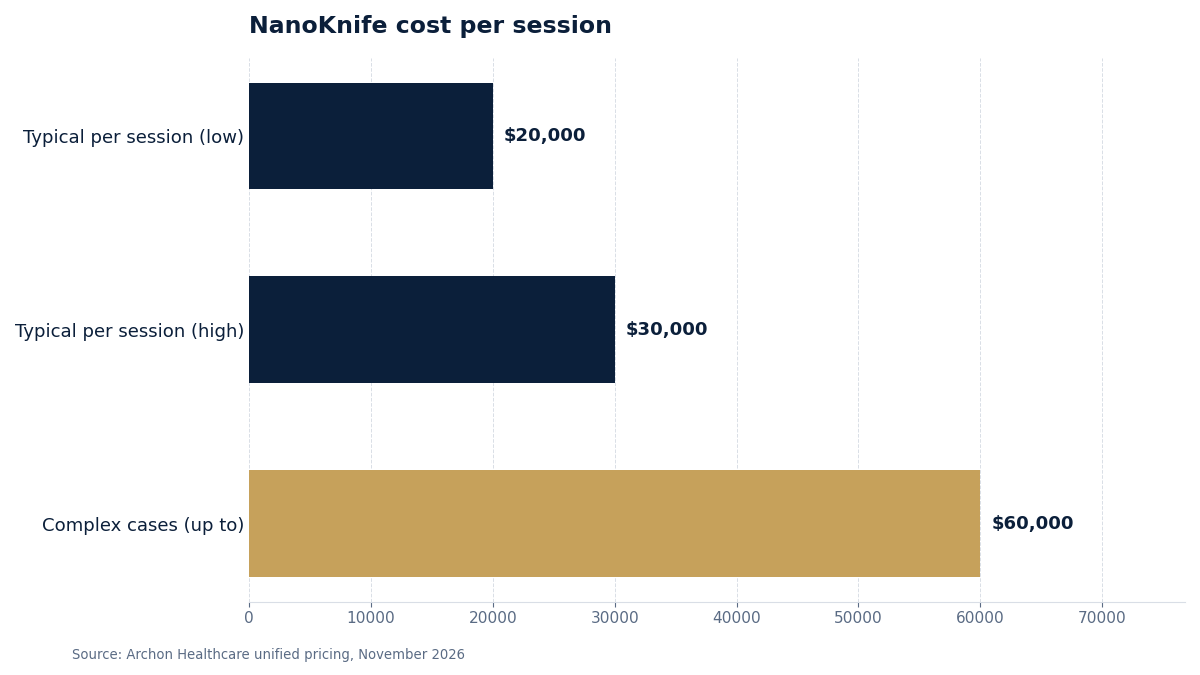
On cost, only one figure in this guide comes from Archon, and it covers NanoKnife. Archon quotes NanoKnife at $20,000 to $30,000 for a typical session, and up to $60,000 in complex cases, with the exact figure set in the written plan after the oncology board reviews the case. No cost figure is given here for immunotherapy or other targeted drugs, because the price turns on the drug, the dose, and the number of cycles.
Is proton therapy available in Guangzhou?
Yes. Guangzhou Concord Cancer Center runs the first Varian ProBeam proton system in South China, and its proton centre has been operating since December 2024. Concord is a separate hospital and is not an Archon partner hospital. Proton therapy suits selected patients only, and suitability is decided after a medical review of the scans and the diagnosis.
Proton therapy is a form of radiotherapy. The beam can be shaped so most of its energy lands inside the tumour, with less dose reaching the healthy tissue behind it. That matters most when the tumour sits close to something that cannot take much radiation, such as the brain, the spinal cord, or the eye. The centre evaluates head and neck cancers, brain tumours, breast, prostate, liver and lung cancers, paediatric tumours and sarcomas, and states plainly that suitability is decided case by case.
Neither Modern Cancer Hospital Guangzhou nor Zhujiang Hospital lists proton therapy among its own treatments, so do not assume a Guangzhou plan includes it. If proton therapy is the question, the enquiry goes to Concord directly, as a separate matter from a Modern or Zhujiang plan. Concord is named here as a Guangzhou facility, not as a partner.
How a Guangzhou plan is put together
A Guangzhou plan starts with the same set of papers whichever hospital you approach: recent scans, the biopsy or pathology report, blood tests, and the treatment history so far. The hospital's multidisciplinary team reads the case and sends back a written plan with itemised costs. Travel, visa papers, and payment all follow from it, and a change to the plan after arrival needs your written approval before it proceeds.
The review usually takes a few days, and the exact time is set by the hospital once it has the full file. A thin file slows everything down. The most common gap is the pathology report without the biopsy blocks or slides, or scans sent as phone photos instead of the original digital files. Send the originals where you can.
What to ask before you travel
Five questions cover most of the ground, and they are worth asking in writing. Ask which option the team proposes and why it fits your cancer type. Ask what test results the proposal rests on. Ask what the plan includes and what sits outside it, including drugs, stay, and follow up imaging. Ask how long the stay runs and what happens if the plan changes mid course. Ask who reviews the case after you return to Dhaka.
Frequently asked questions
What is immunotherapy for cancer? It is drug treatment that helps the patient's own immune system recognise and attack cancer cells, used in Guangzhou mainly as part of a combined plan.
Which targeted therapies are available in Guangzhou? Modern Cancer Hospital Guangzhou lists targeted therapy among its 18 minimally invasive technologies, while Zhujiang Hospital runs CAR-T cell therapy for blood cancers.
Is proton therapy available? Yes, at Guangzhou Concord Cancer Center, which runs the first Varian ProBeam proton system in South China and has been operating since December 2024. Concord is not an Archon partner hospital.
Do I need molecular testing before targeted therapy? In most cases yes. Targeted drugs act on specific changes in the tumour, so the team needs the pathology report and usually molecular or biomarker testing before it can name a drug.
How do I get a written plan for Guangzhou treatment? Share recent scans, the biopsy or pathology report, blood tests and treatment history, and the hospital team sends a written plan with itemised costs before you decide to travel.
What to remember
- Modern Cancer Hospital Guangzhou offers targeted therapy and immunotherapy in combined minimally invasive plans, and lists 18 technologies including NanoKnife and cryotherapy.
- Zhujiang Hospital runs CAR-T cell therapy for blood cancers through its haematology department, which is a different lane from solid tumour treatment.
- Proton therapy exists in Guangzhou at Concord Cancer Center, a separate hospital that is not an Archon partner, and it suits selected patients only.
- Get the written plan first, with the drug, the test result, and the cost named together.
Sources checked 23 November 2026: Modern Cancer Hospital Guangzhou treatment pages at asiancancer.com and moderncancerhospital.net; Guangzhou Concord Cancer Center proton centre page at concord-hospital.org; Zhujiang Hospital CAR-T cooperation page at zjyy.com.cn.
To start a case review, share your reports through the Archon intake form. Related reading: Cancer Treatment Cost in China and Immunotherapy in China for Cancer Patients.
Discuss your case with us, free
Share your reports and get an honest opinion: the right hospital, the written estimate, and whether you should travel at all.
Chat on WhatsAppEmail Us