China · Visa
China Medical Visa Requirements Bangladesh: S1 and S2 Guide

Bangladeshi patients travelling to China for treatment apply for an S2 visa, the private affairs visa for stays of up to 180 days. The Chinese Embassy in Dhaka lists medical treatment under S2, and the hospital letter is the document the application turns on. A bank deposit certificate of no less than 10,000 US dollars is also required.
Do Bangladeshi patients need a visa for medical treatment in China?
Yes. Bangladeshi passport holders need a visa before travelling to China for treatment. There is no separate medical visa category in Chinese law. Patients apply for an S2 visa for private affairs, and the Chinese Embassy in Dhaka lists medical treatment under that category, with a hospital letter as the key document.
What is the difference between a China S1 and S2 visa?
The difference is the length of stay. An S2 visa is for private affairs of no more than 180 days, and that is the category the Dhaka embassy lists for medical treatment. An S1 visa is for private affairs of more than 180 days. If your treatment plan runs past 180 days, the S1 category is the one that applies.
What documents does a China medical visa need?
The embassy in Dhaka asks for three things. First, an invitation letter, hospitalisation confirmation or pre-admission proof from the hospital in China. Second, an original bank deposit certificate of no less than 10,000 US dollars. Third, for each accompanying family member, proof of kinship and an accompanying proof issued by the same hospital.
S1 and S2 side by side
The table below states the embassy rules as published in the Chinese Embassy in Bangladesh notice on visa applications, checked on 23 November 2026. The full notice is published at bd.china-embassy.gov.cn.
| Visa | Stay | Who it covers |
|---|---|---|
| S2, medical treatment | No more than 180 days | Patients seeking treatment in China, and their accompanying family members |
| S1, private affairs | More than 180 days | People who need to come to China for personal matters lasting over 180 days |
Most treatment trips fall under S2. A cancer plan with several cycles, or a stay that the hospital letter puts past six months, is the case where S1 comes into the picture. The hospital letter decides which category fits, because it states the treatment and the expected length of stay. Patients travel to the city of the hospital treating them, whether that is Guangzhou, Kunming or another treatment centre, and the letter names that hospital.
The document checklist
Work through this list in order, and tick each item off only when the paper is in your hand. The list follows the embassy notice for S2 medical treatment applications from Bangladesh.
- Passport, valid for at least 6 months, with blank pages for the visa.
- Completed online visa application form, filled in on the Chinese Visa Application Service Center website at visaforchina.cn, with the supporting documents uploaded as the system prompts.
- Recent passport photograph, taken within the last 6 months.
- Invitation letter, hospitalisation confirmation or pre-admission proof issued by the hospital in China that will treat you. The letter should state your name, the treatment, the dates and the hospital details.
- Original bank deposit certificate of no less than 10,000 US dollars. The embassy notice specifies an original certificate, so a photocopy will not do for this item.
- For each accompanying family member: proof of kinship, and an accompanying proof issued by the hospital in China.
- Medical reports that support the treatment plan, in English, so the hospital letter and the application tell the same story.
For papers the embassy notice does not mark as original, copies may be submitted. Papers marked original must be shown to the Visa Center counter staff when you submit your passport. Keep the originals together in one folder, and keep a photocopy set at home in Dhaka.
How the application runs in Dhaka
Apply online first. Fill in the form on the Visa Application Service Center website and upload the documents the system asks for. The embassy notice says the preliminary review result typically comes within one working day. If the result asks you to modify the form or add a document, do it promptly and resubmit, since the application then goes back into preliminary review.
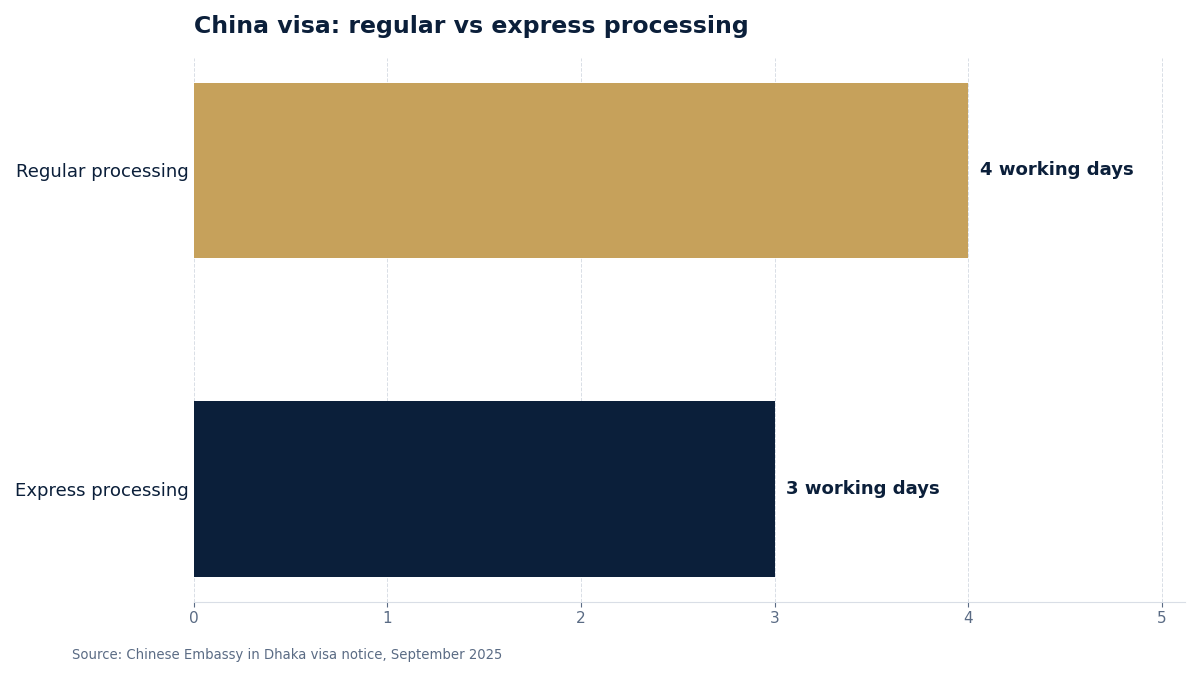
Once the online review is complete, take your passport and the required documents to the Visa Application Service Center to submit them, give biometrics if required, and pay the visa fee. No appointment is needed for this step. Regular processing usually takes 4 working days from the day of passport submission, and express processing takes 3 working days. Applicants under 14 or over 70, and those who gave fingerprints with the same passport in the past five years, are exempt from fingerprint collection.
The embassy notice also warns applicants about agencies. It says the embassy has not authorised any agency as an exclusive visa service provider, and it asks applicants to disregard rumours about application problems and inflated fees. If an agency quotes you a fee far above the published visa fee, or promises a visa without the hospital letter, walk away. The hospital letter and the deposit certificate are the papers that matter, and no agency can replace either of them.
Attendants: who can travel with you
In principle, no more than two people may accompany the patient, and they must be family members of the patient. Each attendant needs proof of kinship and an accompanying proof issued by the hospital in China. Friends and paid carers do not qualify under the embassy rules for S2 medical treatment.
Decide who travels before the hospital writes its letter, so the letter can name the attendants and the accompanying proofs can be issued with it. An attendant added after the visa is filed means a fresh round of papers and a second letter from the hospital. For a patient who needs help walking, eating or taking medicines, the attendant is part of the treatment plan, so settle it early and put it in writing.
Frequently asked questions
Do Bangladeshi patients need a visa for medical treatment in China? Yes. Bangladeshi passport holders need a visa before travelling to China for treatment. There is no separate medical visa category in Chinese law. Patients apply for an S2 visa for private affairs, and the Chinese Embassy in Dhaka lists medical treatment under that category, with a hospital letter as the key document.
What is the difference between a China S1 and S2 visa? The difference is the length of stay. An S2 visa is for private affairs of no more than 180 days, and that is the category the Dhaka embassy lists for medical treatment. An S1 visa is for private affairs of more than 180 days. If your treatment plan runs past 180 days, the S1 category is the one that applies.
What documents does a China medical visa need? The embassy in Dhaka asks for three things. First, an invitation letter, hospitalisation confirmation or pre-admission proof from the hospital in China. Second, an original bank deposit certificate of no less than 10,000 US dollars. Third, for each accompanying family member, proof of kinship and an accompanying proof issued by the same hospital.
To start a case, share your reports through our patient intake form. We review them with the hospital, arrange the invitation letter, and help with the visa papers.
Last reviewed: 23 November 2026
Discuss your case with us
Share your reports and get an honest opinion: the right hospital, the written estimate, and whether you should travel at all.
Chat on WhatsAppEmail Us