China · Cancer
Cancer Treatment in China for Bangladeshi Patients: NanoKnife, Cryotherapy, and When China Makes Sense
Cancer treatment in China gives Bangladeshi patients access to NanoKnife and cryotherapy, two minimally invasive options used when surgery is risky or a tumour sits close to blood vessels. NanoKnife typically costs $20,000 to $30,000 per session in Archon's unified pricing, and up to $60,000 in complex cases. A written estimate from the hospital confirms the figure before travel.
What cancer treatments in China are available to Bangladeshi patients?
Chinese oncology centres offer surgery, chemotherapy, radiotherapy, targeted therapy, immunotherapy, cryotherapy and NanoKnife, and the treating hospital's oncology board chooses from these after reviewing scans and pathology. Availability varies by hospital and by case, so no single list fits every patient. Archon sends your reports first and the board replies with the options that fit your diagnosis.

When does China make sense for cancer treatment?
China makes sense when a tumour is hard to reach by surgery, when a minimally invasive option could shorten recovery, or when a second opinion would help the decision. It also suits patients who want a written plan and itemised costs before flying. When local care can handle the case well, staying home is the better call.
What does NanoKnife cost in China?
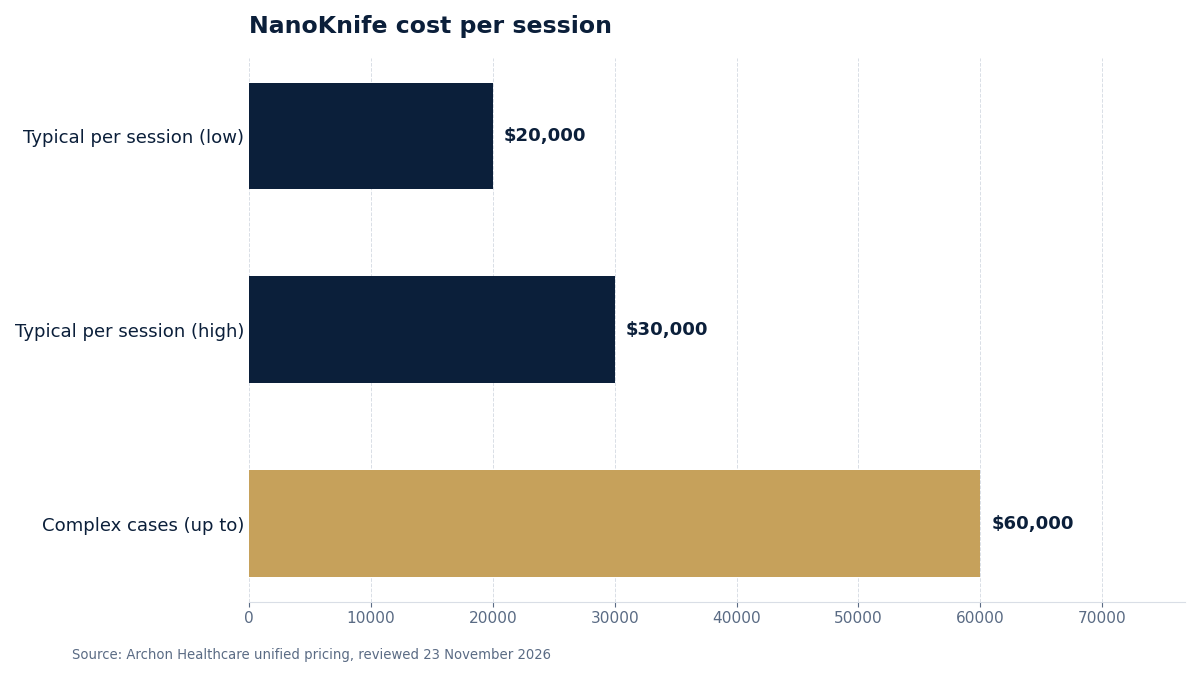
NanoKnife typically costs $20,000 to $30,000 per session in Archon's unified pricing, and the figure can reach $60,000 in complex cases where the tumour is large or sits near structures that need extra care. The treating hospital confirms the exact cost in a written estimate after reviewing your scans. No session price is fixed before that review.
| Item | Figure | Source and date |
|---|---|---|
| NanoKnife, typical per session | $20,000 to $30,000 | Archon Healthcare unified pricing, reviewed 23 November 2026 |
| NanoKnife, complex cases | Up to $60,000 per session | Archon Healthcare unified pricing, reviewed 23 November 2026 |
No other treatment price is quoted on this page. Cryotherapy and any further treatment are priced only in the written estimate for your own case, after the oncology board has reviewed your reports.
How NanoKnife works
NanoKnife is the brand name for irreversible electroporation, often shortened to IRE. Thin probes are placed into or around the tumour under imaging guidance, and the system sends short high voltage electrical pulses through them. The pulses open tiny permanent pores in the cancer cell membranes, and the cells lose the ability to keep their internal balance and die. Because the method is non thermal, it does not rely on heat or cold to destroy tissue. Published reviews describe IRE as a non thermal ablation method that uses high voltage current to induce cell death, and note that the NanoKnife system is the IRE device in wide clinical use. The practical point for patients is that NanoKnife can treat tumours that sit close to blood vessels, bile ducts and nerves, where heat based ablation would risk damage to those structures. Treatment takes place under general anaesthesia, and the oncology board decides whether the tumour size and position suit it. Liver, pancreatic and prostate tumours are among the cases doctors consider most often, and the board may still advise a different option after seeing the scans.
How cryotherapy works
Cryotherapy, also called cryoablation or cryosurgery, destroys cancer cells with extreme cold. Thin metal probes are placed into the tumour under ultrasound, CT or MRI guidance, and a gas circulating through the probes freezes the tissue around them. Ice crystals form inside and outside the cells, the cell membranes break, and blood flow to the frozen area stops during thawing. Doctors usually repeat the freeze and thaw cycle to cover the tumour fully. Mayo Clinic describes cryoablation as a minimally invasive procedure that uses extreme cold directly on cancer cells, and notes it is often used when surgery is not an option. The freezing zone can be watched on imaging while the procedure runs, which helps the doctor shape the treated area. Cryotherapy is used for several tumour types, and the treating hospital confirms whether it fits your case.
NanoKnife and cryotherapy side by side
| NanoKnife | Cryotherapy | |
|---|---|---|
| How it destroys cells | Electrical pulses open permanent pores in cell membranes | Freezing forms ice crystals that break cells apart |
| Heat or cold | Neither, it is non thermal | Extreme cold through the probes |
| Guidance | Ultrasound or CT imaging | Ultrasound, CT or MRI imaging |
| Anaesthesia | General anaesthesia | General anaesthesia in most cases |
| Often considered when | The tumour sits near vessels, ducts or nerves | Surgery is not an option and the tumour can be reached with probes |
Neither option suits every tumour. Size, position, stage and your general health all shape the choice, and the oncology board weighs these together before it recommends one.
What the written estimate should include
Ask for the estimate in writing before you book flights. A clear estimate names the procedure, the hospital stay, anaesthesia, medicines given during admission and the follow up imaging after the session. It should also name what sits outside the figure, since that is where surprises usually come from. Extra sessions, an extended stay, take home medicines, companion stay and food, and flights are commonly separate. Read the estimate line by line and ask the hospital to confirm anything unclear in writing. If the plan changes after arrival, the change and its cost need your written approval before anything proceeds. That rule protects you from a bill that grows without your knowledge.
Who should pause before travelling
Travel is not right for every patient. If you are too unwell to fly safely, if your reports are incomplete, or if your doctor advises urgent care close to home, deal with that first. A second opinion from the Chinese oncology board can still help in those cases, since the board reviews your existing scans without you travelling. The board sometimes advises that local treatment can handle the case well, and that answer saves a trip that would not have changed the outcome. Families should also plan for the practical side, including who travels with the patient and how follow up care will work back in Dhaka.
How to start
Start by gathering recent scans, the biopsy or pathology report, blood tests and a summary of treatment so far. Archon sends these to the treating hospital, and the oncology board reviews them and replies with a written plan and itemised costs. Modern Cancer Hospital Guangzhou is one of the hospitals in Archon's signed network in Guangzhou. Once you accept a plan, the hospital issues the invitation letter needed for the visa, and travel planning begins. Submit your reports through the intake form below, and Archon will confirm what else the hospital needs before the board review starts.
Frequently asked questions
Do I pay the hospital directly? Yes. Your treatment contract and billing are with the hospital. Archon coordinates the case and never takes a cut of your medical bill.
What if the plan changes mid-treatment? The oncology board may adjust the plan based on response. Any change, and its cost, needs your written approval before it proceeds.
Where can I read more about cancer costs in China? Our cancer treatment cost guide for China explains how written estimates work, and the cryosurgery guide covers freezing treatment in more detail.
Submit your reports through the Archon Healthcare intake form to start a written estimate.
What to remember
- NanoKnife typically costs $20,000 to $30,000 per session in Archon's unified pricing, and up to $60,000 in complex cases.
- NanoKnife uses electrical pulses and no heat, which suits tumours near vessels and ducts.
- Cryotherapy freezes the tumour through probes placed under imaging guidance.
- Get the plan and the itemised costs in writing before you fly, and approve any change in writing.
- A second opinion from the oncology board comes before any travel decision.
Sources: Mayo Clinic, Cryoablation for cancer, mayoclinic.org; Irreversible Electroporation, a review of the NanoKnife IRE system, pmc.ncbi.nlm.nih.gov.
Discuss your case with us, free
Share your reports and get an honest opinion: the right hospital, the written estimate, and whether you should travel at all.
Chat on WhatsAppEmail Us