Visa · Attendants
How many attendants can travel with a patient? Rules by country

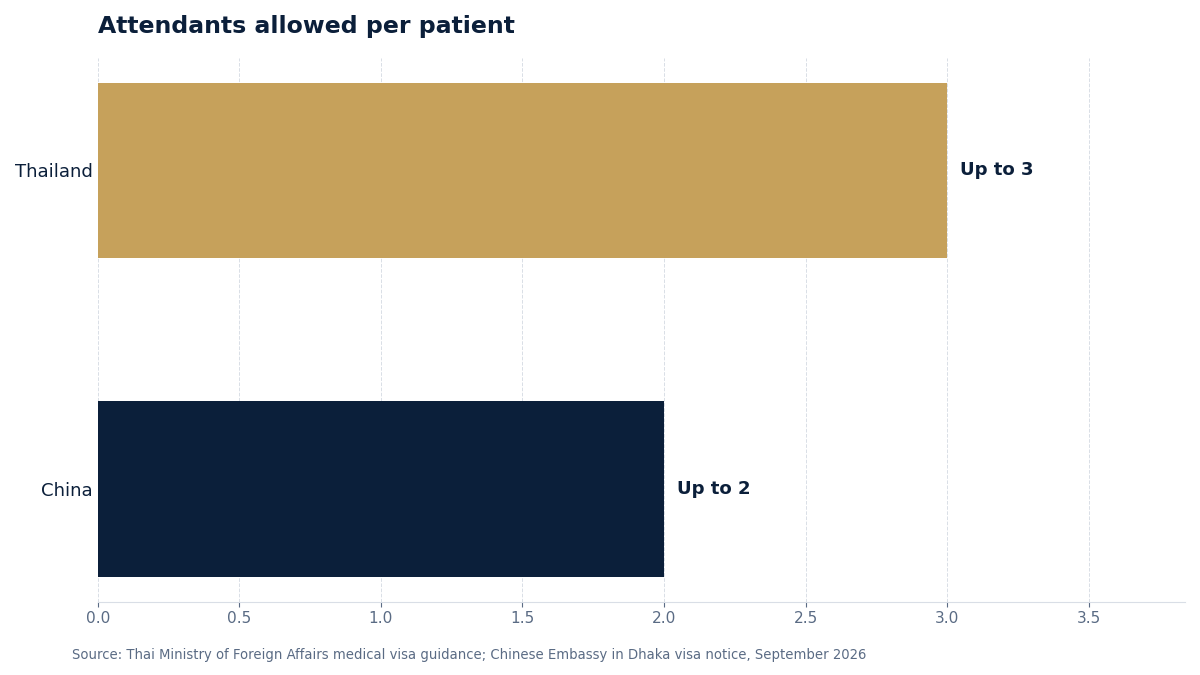
The number depends on the country you are travelling to. Thailand allows up to 3 accompanying immediate family members on its medical visa route, and China allows up to 2 accompanying family members on an S2 visa. Korea, Turkey and Pakistan publish no fixed attendant number, so the hospital letter and the embassy decide each case.
Most patients do not travel alone. A spouse, a parent or an adult child usually comes along to handle the hospital paperwork, stay with the patient after a procedure and manage the daily routine in a foreign city. The visa rules for that person are separate from the patient rules, and they change from one country to the next. This guide sets out the attendant limits we could verify from official sources, so you can plan who travels before you book anything.
How many attendants are allowed?
Thailand allows up to 3 accompanying immediate family members on its medical visa route, according to the Thai Ministry of Foreign Affairs medical visa guidance. China allows up to 2 accompanying family members on an S2 visa, according to the Chinese Embassy in Dhaka. Korea, Turkey and Pakistan publish no fixed number, so the count is settled case by case.
The table below is the short version. Read the country sections under it before you decide who goes, because the number is only part of the rule. Who counts as family, which visa the attendant applies for and what the hospital letter must say all matter as much as the count.
| Country | Attendants allowed | Attendant visa | Source checked |
|---|---|---|---|
| Thailand | Up to 3 immediate family members | Medical visa route, attendant named in the file | Thai Ministry of Foreign Affairs, medical treatment visa guidance |
| China | Up to 2 family members | S2, same category as the patient | Chinese Embassy in Dhaka, visa notice, September 2026 |
| South Korea | No fixed number published | C-3-3 for stays up to 90 days, G-1-10 for longer stays | Korea Tourism Organization, medical tourism visa issuance |
| Turkey | No fixed number published | Own visa by nationality, hospital letter as support | Turkish Law 6458, Article 31, treatment residence permit |
| Pakistan | No fixed number published | Medical visa covers patient, family and attendants | Directorate General of Immigration and Passports, visa categories |
Does the attendant need their own invitation letter?
Yes, in practice every attendant needs their own visa and their own file. The hospital invitation letter should name the attendant, and the attendant adds proof of relationship to the patient, a passport, photos and evidence of funds for the stay. A letter that names only the patient leaves the attendant with nothing to show the embassy.
Ask the hospital to name each attendant in the invitation letter before you file. The letter should give the attendant full name exactly as it appears on the passport, the relationship to the patient and the planned dates. For China, the hospital also issues an accompanying proof for each attendant, and the embassy notice asks for that document alongside proof of kinship. For Korea, the invitation comes from the registered medical institution or the registered facilitator, and the companion is documented alongside the patient in the same invitation process.
Proof of relationship is usually a marriage certificate for a spouse or a birth certificate for a parent or child. Carry the original and a photocopy, and check whether the embassy wants the document notarised. Some embassies ask for an English version of a Bangla certificate, so leave time for that step.
Can a child travel as an attendant?
A child can travel as a family member accompanying a patient, with a passport, a birth certificate proving the relationship, and a visa in the same category as the patient. A child cannot act as the main caregiver, so an adult attendant should travel as well. The adult attendant carries the caregiving role.
For a child patient, the position is reversed. Korea recognises the need for a parent or guardian to accompany a child patient, and the guardian applies under the same medical visa category as the child. China applies the same family rule, with the parent named as the accompanying family member. In both cases the hospital letter should name the parent as the attendant, and the birth certificate proves the link.
Thailand: up to 3 immediate family members
Thailand has the clearest published limit. The Thai Ministry of Foreign Affairs medical treatment guidance covers the patient and accompanying persons, with no more than 3 accompanying immediate family members. Each companion applies in their own right, and the hospital appointment letter supports the file. The VFS checklist used for Bangladesh files lists attendants under the tourist category, with proof of relationship to the patient, so confirm the current filing route with the embassy in Dhaka before you submit.
China: up to 2 family members on an S2 visa
China is strict on who counts. The Chinese Embassy in Dhaka states that the number of accompanying persons shall not exceed 2, limited to family members of the patient, who must submit proof of kinship and accompanying proof issued by the hospital in China. The attendant applies for the same S2 visa as the patient when the stay is up to 180 days, and for an S1 visa when the stay runs longer.
The embassy notice also asks the patient for an invitation letter, hospitalisation confirmation or pre-admission proof from the hospital in China, and a bank deposit certificate of no less than 10,000 USD. Attendants should expect to show their own funds evidence as well. Friends and paid caregivers do not qualify as accompanying family members under this rule.
South Korea: family and guardians under C-3-3
Korea publishes no attendant number. The Korea Tourism Organization states that the C-3-3 medical tourist visa is issued to invited foreign patients and includes family members or guardians who need to accompany the patient for caregiving purposes. The stay is up to 90 days. Treatment of 91 days or more falls under the G-1-10 visa, which also covers a family member or caregiver travelling with the patient.
Turkey: no separate attendant visa category
Turkey has no separate attendant visa category. Each person travelling with the patient applies for their own visa under the rules for their nationality, and the hospital invitation letter can name the companion as support. For longer stays, Turkish Law 6458 Article 31 provides a medical treatment residence permit for the patient, and first-degree relatives caring for them can apply on the same ground, with proof of relationship and a hospital letter naming the caregiver.
Pakistan: medical visa covers family and attendants
Pakistan publishes no attendant number either. The Directorate General of Immigration and Passports lists a short term medical visa for up to 3 months, issued within 48 hours, and an extended medical visa for up to one year. Both cover the patient, family members and attendants, so list everyone who will fly with the patient on the application and keep the relationship clear.
What to file for each attendant
Use this list for each person travelling with the patient, and tick each item off before you submit.
- Passport valid for at least six months, with blank pages for the visa
- Visa application form and recent photos in the format the embassy asks for
- Hospital invitation letter naming the attendant, with the patient name, the treatment and the dates
- Proof of relationship, such as a marriage certificate or birth certificate, original and photocopy
- Evidence of funds for the attendant stay, such as a bank statement in the attendant name or a sponsor letter
- Round trip flight booking and accommodation details matching the patient dates
- For China, the hospital accompanying proof in addition to the invitation letter
- For Korea, the invitation from the registered institution or facilitator naming the companion
File the attendant application at the same time as the patient application. A late attendant file can be reviewed on its own, and the embassy may ask why the person was not listed from the start. If plans change and a second attendant needs to join later, tell the hospital first so the letter can be updated before the new file goes in.
Sources: Thai Ministry of Foreign Affairs medical treatment visa guidance, at image.mfa.go.th; Chinese Embassy in Dhaka visa notice, at bd.china-embassy.gov.cn; Korea Tourism Organization medical tourism visa issuance, at english.visitkorea.or.kr; Turkish Law 6458, Article 31, at goc.gov.tr; Pakistan foreign ministry visa page, at mofa.gov.pk. Check the current page before you file, because embassy rules change.
To start a case with Archon, send your reports through the patient intake form. Our team reads the reports, checks the visa route for your country and tells you which attendants to name in the hospital letter.
Discuss your case with us, free
Share your reports and get an honest opinion: the right hospital, the written estimate, and whether you should travel at all.
Chat on WhatsAppEmail Us