Bangladesh · Treatment at home
Treatments you can get in Bangladesh: open-heart surgery, kidney transplant, bone marrow transplant

Open-heart surgery, kidney transplant, and bone marrow transplant are all done in Bangladesh. NICVD in Dhaka does bypass and valve surgery, BIRDEM has done living related donor kidney transplants since 2004, and Dhaka Medical College Hospital has done bone marrow transplants since 2014. What matters is whether your case fits what local teams can do.
Can open-heart surgery be done in Bangladesh?
Yes. Open-heart surgery, including valve replacement and bypass surgery, is done regularly at the National Institute of Cardiovascular Diseases in Dhaka, which was established in 1978 as the country's specialist cardiovascular institute. Its cardiac surgery teams do bypass operations, including off-pump bypass, and valve replacement as routine work.
That does not mean every heart case belongs at NICVD, and it does not mean every patient should stay. A patient with a straightforward bypass or valve problem can usually be treated well in Dhaka, close to family and to the doctor who will do the follow-up. A patient with a rare congenital defect or a repeat operation after earlier surgery may still benefit from a second opinion abroad. The line is drawn case by case, and your cardiologist is the one who draws it.
Ask your heart surgeon how many operations like yours the team does in a year, and what the plan would be if something goes wrong during the operation. A team that answers those questions plainly is a team you can trust, whether it works in Dhaka or anywhere else.
Where is kidney transplant done in Bangladesh?
Kidney transplant is done in Bangladesh, and the country's first successful kidney transplant was done in October 1982 at the institute that is now Bangabandhu Sheikh Mujib Medical University. BIRDEM General Hospital in Dhaka began living related donor kidney transplant on 6 November 2004, and its team reported 111 such transplants between 2004 and 2014.
The donor rule is the part every family must understand. In Bangladesh, living kidney donation is limited to close relatives, and the transplant team checks the relationship and the donor's health before anything proceeds. That rule protects both the donor and the patient, and it is not something any facilitator can work around.
A transplant means more than the operation itself. The patient needs lifelong follow-up, regular blood tests, and medicines that suppress the immune system. That follow-up happens in Dhaka whether the transplant is done here or abroad, which is one more reason to keep your local nephrologist involved from the start. If your family has a willing related donor and the team accepts the case, staying home is often the simplest path.
When does a second opinion abroad make sense?
A second opinion abroad makes sense when your local team is unsure, when the case is rare or high risk, or when the treatment you need is not offered here. It also makes sense when two Dhaka specialists disagree and you need a third view before deciding.
The most useful form of a second opinion is a written review of your existing scans and reports by the foreign hospital's specialists. You do not need to travel for that. The hospital reads the same reports your Dhaka doctor has, and writes back with its view and a cost estimate. If that view agrees with your local team, you have your answer without leaving home. If it differs, you have a real choice to make, and the difference is written down.
When a second opinion abroad does point to travel, the reasons are usually specific: a procedure that is not done here, a team that handles far more cases like yours, or a technology that changes the plan. Ask for the reason in writing. A second opinion that cannot name what it adds is not a second opinion worth paying for.
What local capacity looks like in practice
| Treatment | What is available in Bangladesh | Source and date |
|---|---|---|
| Open-heart surgery | Valve replacement and bypass surgery done regularly at NICVD, Dhaka | Banglapedia, National Institute of Cardiovascular Diseases entry |
| Kidney transplant | First successful transplant in October 1982; 111 living related donor transplants at BIRDEM between 2004 and 2014 | BIRDEM Medical Journal, 2018 |
| Bone marrow transplant | First transplant in March 2014 at Dhaka Medical College Hospital; 60 transplants done there by October 2025 | The Daily Star, 11 October 2025 |
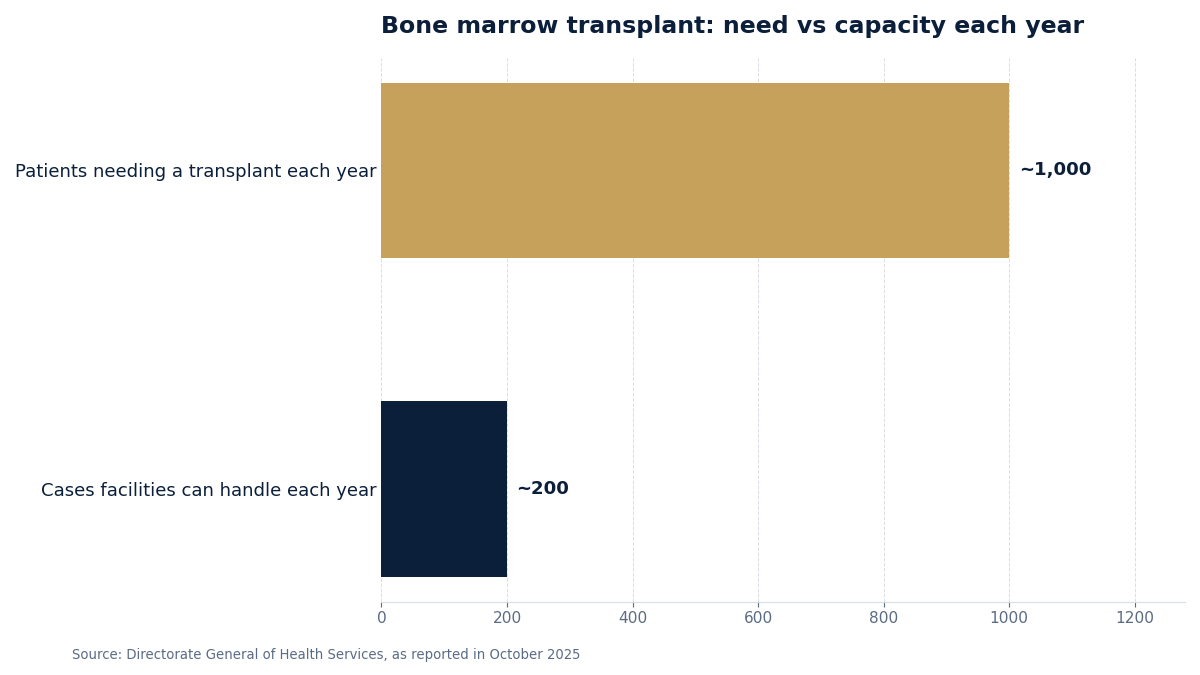
| Bone marrow transplant capacity | Around 1,000 patients need a transplant each year in Bangladesh, while public and private facilities together can handle around 200 cases a year | Directorate General of Health Services, reported by The Daily Star, 11 October 2025 |
The bone marrow transplant figures show the gap plainly. Around 1,000 patients need a bone marrow transplant each year in Bangladesh, while public and private facilities together can handle around 200 cases a year, according to the Directorate General of Health Services as reported in October 2025. Dhaka Medical College Hospital's unit resumed work in October 2025 after a long break, and it can do around 50 to 60 transplants a year across its five beds. That capacity is real, and it is also limited, which is why waiting lists exist and why some families look abroad.
The kidney transplant record tells a steadier story. BIRDEM's team reported 111 living related donor transplants between 2004 and 2014, and the programme has continued since. The first successful transplant in the country dates to October 1982. A family with a willing related donor is not starting from nothing in Dhaka. The team, the follow-up clinic, and the medicines are already here.

Where the gaps still are
The gaps are capacity and complexity, and not the absence of the treatments themselves. Bone marrow transplant has few beds and long waits. Kidney transplant depends on finding a suitable related donor. Open-heart surgery is well established, and the harder cases are the ones that still need a wider discussion.
Those gaps are the honest reason some patients travel, and they are also the reason others should not. If your case fits what a Dhaka team does routinely, the trip adds cost and strain without adding medicine. If your case sits in one of the gaps, a written second opinion from abroad is the cheapest way to find out whether travel would actually help.
How Archon uses second opinions
Archon starts with your existing reports and gets a written opinion from the foreign hospital's specialists before anyone books a flight. If the specialists say the case can be handled in Dhaka, that is what you are told. If they say travel would help, you get the written plan and the cost estimate, and you decide with your own doctor.
That order matters. A second opinion that comes before the travel decision protects you from a trip you do not need. A trip that comes before the second opinion protects no one. Share your reports through the intake form below if you want a written opinion on your case, and keep your Dhaka doctor in the conversation throughout.
To share your reports and get a written opinion on your case, use our patient intake form.
Sources: Banglapedia, National Institute of Cardiovascular Diseases · BIRDEM Medical Journal, 2018 · The Daily Star, 11 October 2025
Frequently asked questions
Can open-heart surgery be done in Bangladesh? Yes. Valve replacement and bypass surgery are done regularly at the National Institute of Cardiovascular Diseases in Dhaka, the country's specialist cardiovascular institute since 1978.
Where is kidney transplant done in Bangladesh? Kidney transplant is done at BIRDEM General Hospital in Dhaka, which began living related donor transplant in November 2004, and at other specialist centres. Living donation is limited to close relatives.
When does a second opinion abroad make sense? When your local team is unsure, when the case is rare or high risk, when the treatment is not offered here, or when two Dhaka specialists disagree. Get the opinion in writing on your existing reports before booking travel.
Last reviewed: 23 November 2026
Discuss your case with us, free
Share your reports and get an honest opinion: the right hospital, the written estimate, and whether you should travel at all.
Chat on WhatsAppEmail Us